WordPress Website Development in India: When It Still Makes Sense (2026)
WordPress website development is the process of building a website on WordPress — the world's most popular content management system (CMS) that powers over 40% of all websites — using themes, plugins and a visual dashboard so non-technical owners can manage their own content.
With custom-coded Next.js sites getting all the attention in 2026, business owners often ask: “Is WordPress still worth it?” The honest answer is yes — for the right project. WordPress isn't outdated; it's simply the wrong tool for some jobs and the perfect tool for others.
This guide cuts through the hype. It covers exactly when WordPress still makes sense in India, when it does not, what a good WordPress build actually costs, what a quality build includes, and how to hire a developer who builds it properly — not a slow, plugin-stuffed mess.
Not sure if WordPress is right for your business?
Book a free consultation — we'll tell you honestly whether WordPress or custom Next.js fits your goal, with a fixed-price quote either way.
At a Glance: WordPress Development in India (2026)
- WordPress powers 40%+ of all websites worldwide — still the most popular CMS
- Best for content-heavy sites, blogs, and owners who want to self-edit
- WordPress business sites in India cost ₹25,000–₹75,000 in 2026
- A good build needs a lightweight theme, few quality plugins and proper hosting
- Poorly built WordPress = slow, insecure; well built = fast and reliable
- For high-scale, performance-critical or app-like sites, custom Next.js wins
- Choose the platform by your goal — not by trend
Is WordPress Still Relevant in 2026?
Yes — overwhelmingly. WordPress powers more than 40% of all websites on the internet (Source: W3Techs), from small business sites to major publishers. That scale means a huge ecosystem of themes, plugins, tutorials and developers — and it isn't going anywhere.
What has changed is the expectation. In 2026, a WordPress site can't just exist — it has to be fast, secure and mobile-first, the same as any modern website. The platform is fully capable of that. The difference between a great WordPress site and a painful one isn't WordPress itself — it's how it's built.
That distinction matters more than any platform debate. Two businesses can commission a WordPress site in the same month, at similar budgets, and end up with completely different outcomes: one loads in under two seconds and ranks well, the other takes eight seconds and gets hacked within a year. Same CMS, different builder. Everything in this guide is about landing on the right side of that split.
When Does WordPress Still Make Sense for an Indian Business?
WordPress is genuinely the smart choice in these cases:
- Content-heavy sites — blogs, news portals, magazines, resource libraries where you publish often
- You want to self-manage — add pages, edit text, upload photos and publish posts yourself without calling a developer
- Blogs & personal brands — the world's best blogging CMS, with SEO plugins like RankMath and Yoast built for it
- Membership, courses & LMS — plugins like LearnDash and MemberPress make WordPress a strong e-learning base
- Standard business/brochure sites — clinics, consultants, local services that need a professional site on a sensible budget
- Tight budgets & fast launches — a clean WordPress site can go live in 2–3 weeks at a lower cost than custom code
- Frequent content marketing — if SEO blogging is central to your strategy, WordPress makes publishing effortless
If two or more of these describe you, WordPress is likely the right call.
The common thread is content ownership. If your site needs to change every week — new offers, new blog posts, new team members, new product photos — a dashboard you can log into yourself is worth more than raw speed you can't update. That's the trade WordPress makes, and for a large share of Indian small businesses it's the right one.
When Should You NOT Use WordPress?
Being honest matters. WordPress is the wrong tool when you need:
- Maximum performance at scale — very high traffic or thousands of pages where every millisecond counts
- App-like interactivity — dashboards, real-time features, complex web apps
- Bank-grade security with zero plugin risk — plugins are WordPress's biggest attack surface
- A truly unique custom experience — pixel-perfect, one-of-a-kind UX beyond theme constraints
For these, a custom Next.js build is the better long-term choice. We make the full case here: Why Next.js Is Best for Indian Business Websites, and compare both head-to-head here: Next.js vs WordPress 2026.
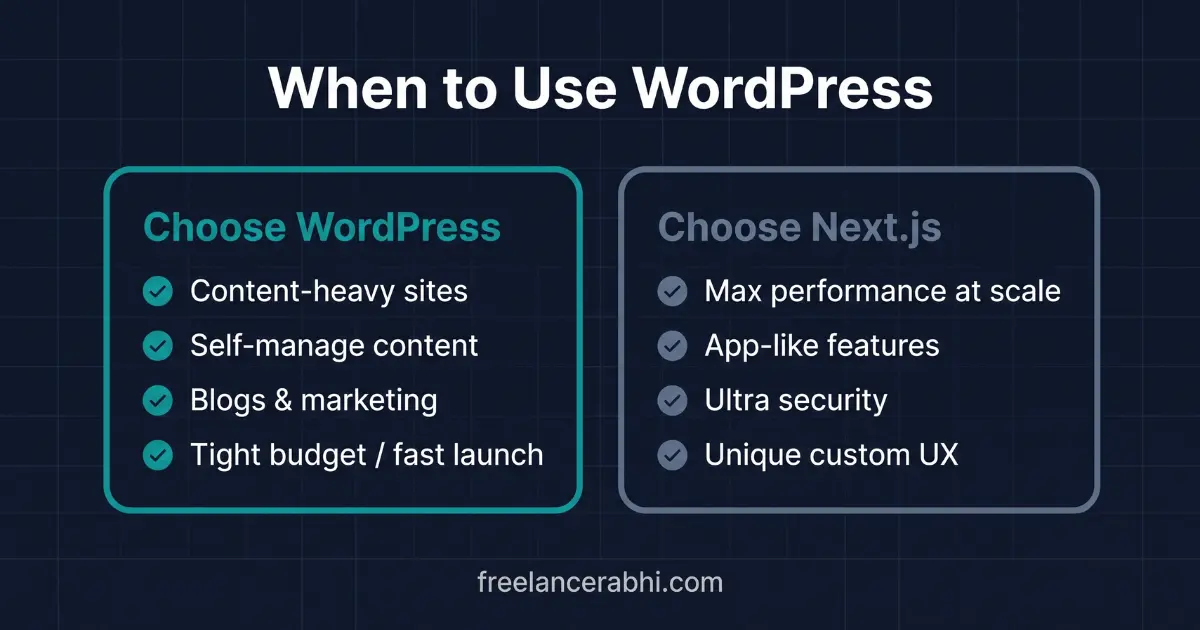
Neither list is a verdict on quality. It's a question of fit: WordPress optimises for content control and speed of launch, custom code optimises for performance ceiling and bespoke experience. Picking the one that matches your actual goal saves far more money than picking the one that's fashionable.
How Much Does a WordPress Website Cost in India?
Pricing depends on scope, design work and how much functionality sits behind the pages. These are the ranges we see across India in 2026:
| WordPress Site Type | Cost Range (India 2026) | Timeline | Best For |
|---|---|---|---|
| Basic business site (5–8 pages) | ₹25,000 – ₹45,000 | 2–3 weeks | Clinics, consultants, local services |
| Content / blog site | ₹35,000 – ₹60,000 | 2–4 weeks | Publishers, content marketers |
| Business + custom design | ₹50,000 – ₹75,000 | 3–4 weeks | Brands wanting a distinct look |
| WooCommerce store | ₹60,000 – ₹1,20,000 | 4–6 weeks | Product businesses, D2C |
| Membership / LMS site | ₹75,000 – ₹1,50,000+ | 4–8 weeks | Course creators, communities |
These are realistic 2026 rates for quality work. Beware sub-₹10,000 “WordPress websites” — they almost always mean a pirated theme, 30 plugins and shared hosting that collapses under real traffic. Ongoing costs also apply: hosting (₹300–₹3,000/mo), premium plugins/theme licences, and maintenance. For the wider picture, see Website Development Cost in Delhi NCR 2026.
One practical note on budgeting: the build fee is a one-time number, but hosting, licences and maintenance repeat every year. When you compare two quotes, compare the three-year cost, not just the invoice on day one. A cheap build that needs rescuing in month eight is the most expensive option on the table.
What Does a Well-Built WordPress Website Include?
The difference between a fast, reliable WordPress site and a slow, hacked one comes down to how it's built:
- A lightweight theme — not a bloated multipurpose theme with features you'll never use
- Minimal, quality plugins — 5–10 well-chosen plugins, not 30 random ones
- Quality managed hosting — proper WordPress hosting, not the cheapest shared plan
- Caching + CDN — for PageSpeed 90+ even on WordPress
- Optimised images — WebP, compressed, correctly sized
- SEO built in — RankMath/Yoast configured, schema, sitemap, clean permalinks
- Security hardening — updates, firewall, limited login attempts, backups
- Mobile-first responsive design — perfect on every screen
A WordPress site built this way easily scores 90+ on Google PageSpeed. A site stuffed with plugins on cheap hosting scores 30. Same platform — completely different result.
If speed is a priority for you (and in a mobile-first market it should be), it's worth understanding what Google actually measures before you sign off on a build: our Core Web Vitals 2026 guide explains LCP, INP and CLS in detail, and 7 Critical Website Speed Issues covers the fixes that move the score most.
What Are the Common WordPress Pitfalls to Avoid?
The reasons WordPress gets a bad reputation are all avoidable:
- Plugin overload — every plugin adds weight and a potential security hole
- Cheap shared hosting — the #1 cause of slow WordPress sites
- Ignoring updates — outdated plugins are the top hacking entry point (Source: Sucuri Hacked Website Report)
- Bloated page builders — heavy builders can drag PageSpeed down if misused
- No backups — one bad update without a backup can wipe your site
Hire a developer who avoids these from day one, and WordPress is fast, secure and low-maintenance.
Notice that not one of these is a flaw in WordPress. Every item is a decision someone made during or after the build — which is exactly why the developer you choose matters more than the platform you choose. If your existing site already shows these symptoms, the warning signs are worth reading: 10 Signs Your Website Needs a Redesign.
How Do You Hire the Right WordPress Developer in India?
Use the same evaluation you would for any developer — live portfolio, real reviews, fixed written pricing, and proof the sites are fast and SEO-ready. Specifically for WordPress, also ask:
- Can you show me live WordPress sites scoring 90+ on PageSpeed?
- Which theme and plugins will you use, and why?
- What hosting do you recommend?
- Is SEO (RankMath/Yoast, schema, sitemap) included?
- What maintenance/support is offered after launch?
A developer who answers these clearly and specifically — naming the theme, naming the host, showing a live score — is a developer who has built this properly before. Vague answers on any of the five are the single most reliable red flag.
For the full hiring framework, read How to Choose the Best Web Developer in India.
Why Choose Freelancer Abhi for WordPress Development
Freelancer Abhi (ABHI & CO., UDYAM-HR-03-0143972), led by Abhishek Sharma, builds WordPress websites that are actually fast — lightweight themes, minimal quality plugins, proper hosting, caching and SEO built in, so they are built to load fast. 7+ years experience, 50+ projects across India and 10+ countries, 4.9/5 from 17 Google reviews.
We're platform-honest: if WordPress is right for you, we build it brilliantly; if custom Next.js would serve you better, we'll tell you. Every project includes SEO, mobile-first design and ongoing support options. WordPress business sites from ₹25,000. Explore the portfolio, read client reviews, see website pricing, or book a free consultation. WhatsApp +91 7048983936.
Tell us what your site needs to do and we'll recommend the right platform — plus a fixed-price quote and timeline. Free, no obligation.
Frequently Asked Questions
Is WordPress still a good choice for a website in 2026?
Yes. WordPress powers over 40% of all websites and remains the best choice for content-heavy sites, blogs, and businesses that want to manage their own content. In 2026, a well-built WordPress site — lightweight theme, quality hosting, caching and SEO — easily scores 90+ on Google PageSpeed. It's only the wrong choice for very high-scale, app-like or ultra-performance-critical projects, where custom Next.js is better.
How much does a WordPress website cost in India?
A basic WordPress business site costs ₹25,000–₹45,000, content and custom-design sites ₹35,000–₹75,000, WooCommerce stores ₹60,000–₹1,20,000, and membership/LMS sites ₹75,000–₹1,50,000+. Ongoing costs include hosting (₹300–₹3,000/month), premium plugin/theme licences and maintenance. Avoid quotes under ₹10,000 — they usually mean pirated themes and no support.
Why are some WordPress websites so slow?
Slow WordPress sites are almost always caused by how they're built, not WordPress itself: too many plugins, bloated multipurpose themes, cheap shared hosting, no caching or CDN, and unoptimised images. A properly built WordPress site with a lightweight theme, minimal quality plugins, good hosting and caching scores 90+ on PageSpeed — the same platform, built well.
WordPress or custom-coded — which is better for my business?
Choose WordPress if you publish content often, want to self-manage your site, or need a professional site on a sensible budget. Choose custom Next.js if you need maximum performance at scale, app-like features, or a truly unique experience. It depends on your goal, not on which is “better” overall. Our Next.js vs WordPress guide compares both in detail.
Do I need technical skills to manage a WordPress website?
No. That's one of WordPress's biggest advantages. Once built, you can add pages, edit text, upload images and publish blog posts yourself through a simple visual dashboard — no coding required. A good developer will also give you a short handover walkthrough so you're comfortable managing day-to-day content on your own.
Conclusion
WordPress is far from dead in 2026 — it's still the best choice for content-heavy sites, self-managed businesses and content marketers, provided it's built properly. The platform isn't the problem; a lazy build is. Choose based on your goal: WordPress for content and control, custom Next.js for maximum performance and scale.
Not sure which fits your business?
Book a free consultation and we'll give you a straight, no-pressure recommendation.
Related Articles You May Also Like
Next.js vs WordPress in 2026: Which Platform Should You Choose?
The full head-to-head comparison — speed, SEO, security, cost and control.
Why Next.js Is the Best Choice for Indian Business Websites in 2026
When performance and scale matter more than a self-edit dashboard.
Website Development Cost in Delhi NCR (2026 Price Guide)
Real 2026 pricing across starter, custom and e-commerce builds.
How to Choose the Best Web Developer in India (2026)
The 7 questions to ask, red flags to avoid, and a hiring scorecard.