Ecommerce Website Development in India: Cost, Platforms & Timeline (2026)
Ecommerce website development is the process of building an online store where customers can browse products, add them to a cart, and pay online — combining product catalogues, secure payment gateways, order management and shipping integration into one working system.
India's ecommerce market is booming. It is projected to reach US$325 billion by 2030, growing at over 20% a year, with more than 60% of orders now coming from tier-2 and tier-3 cities (Source: IBEF India Ecommerce Report). The online shopper base is projected to cross 400 million by 2027 (Source: Bain & Company). Whether you sell handmade products, run a D2C brand or want to take your Delhi NCR retail store online, 2026 is the right time to build.
But “how much does an online store cost?” and “which platform should I use?” are where most business owners get stuck — and overpay. This guide gives you real 2026 costs, an honest platform comparison, realistic timelines, and the features that actually matter.
Ready to sell online?
Book a free consultation and get a straight quote for your store — no jargon, no inflated pricing.
At a Glance: Ecommerce Development in India (2026)
- A basic online store costs ₹40,000–₹95,000; custom builds run ₹1,50,000–₹5,00,000+
- Shopify is fastest to launch; WooCommerce is most flexible; custom Next.js is most scalable
- Most stores launch in 4–8 weeks depending on product count and features
- Razorpay, PayU and Cashfree are the leading India payment gateways
- Shiprocket and Delhivery handle shipping and courier aggregation
- Mobile-first design is essential — 75%+ of Indian ecommerce traffic is mobile
- Ongoing costs (hosting, gateway fees, maintenance) matter as much as the build price
How Much Does an Ecommerce Website Cost in India?
| Store Type | Cost Range (India 2026) | Timeline | Best For |
|---|---|---|---|
| Shopify store (basic setup) | ₹40,000 – ₹90,000 + ₹2,000–₹7,000/mo | 2–4 weeks | Fast launch, small–medium catalogues |
| WooCommerce store (WordPress) | ₹50,000 – ₹1,20,000 | 3–5 weeks | Flexible, content + commerce mix |
| Custom Next.js store | ₹1,50,000 – ₹5,00,000+ | 6–12 weeks | High traffic, unique UX, scale |
| Marketplace-style platform | ₹4,00,000+ | 12+ weeks | Multi-vendor, large operations |
Bar chart comparing ecommerce website build costs in India for 2026: Shopify ₹40,000 to ₹90,000, WooCommerce ₹50,000 to ₹1,20,000, custom Next.js ₹1,50,000 to ₹5,00,000, and marketplace-style platforms ₹4,00,000 and above.
Ecommerce Cost Estimator
Pick a platform and catalogue size to see an estimated 2026 build cost and timeline.
Platform
Catalogue size
Estimated build cost
₹40,000 – ₹90,000
Shopify · 1–25 products · Typical timeline: 2–4 weeks
Indicative 2026 ranges based on Freelancer Abhi project data. Final quotes depend on features, integrations and content readiness. Get an exact quote →
The build price is only part of the picture. Factor in ongoing costs: hosting (₹500–₹5,000/mo), payment gateway fees (~2% per transaction), a domain, SSL, and maintenance. A ₹90,000 Shopify store with monthly fees can cost more over 3 years than a ₹1,50,000 one-time WooCommerce build — plan for the full lifecycle.
For general website pricing, see Website Development Cost in Delhi NCR 2026.
Which Ecommerce Platform Is Best for Indian Businesses?
| Factor | Shopify | WooCommerce | Custom (Next.js) |
|---|---|---|---|
| Setup speed | Fastest | Medium | Slowest |
| Monthly cost | ₹2,000–₹7,000+ | Hosting only | Hosting only |
| Flexibility | Limited to apps | High | Unlimited |
| Scalability | Good | Medium | Excellent |
| Maintenance | Managed by Shopify | You/developer | You/developer |
| Transaction fees | Extra unless Shopify Payments | Gateway only | Gateway only |
| Best for | Quick launch, D2C | Content + shop | High-scale brands |
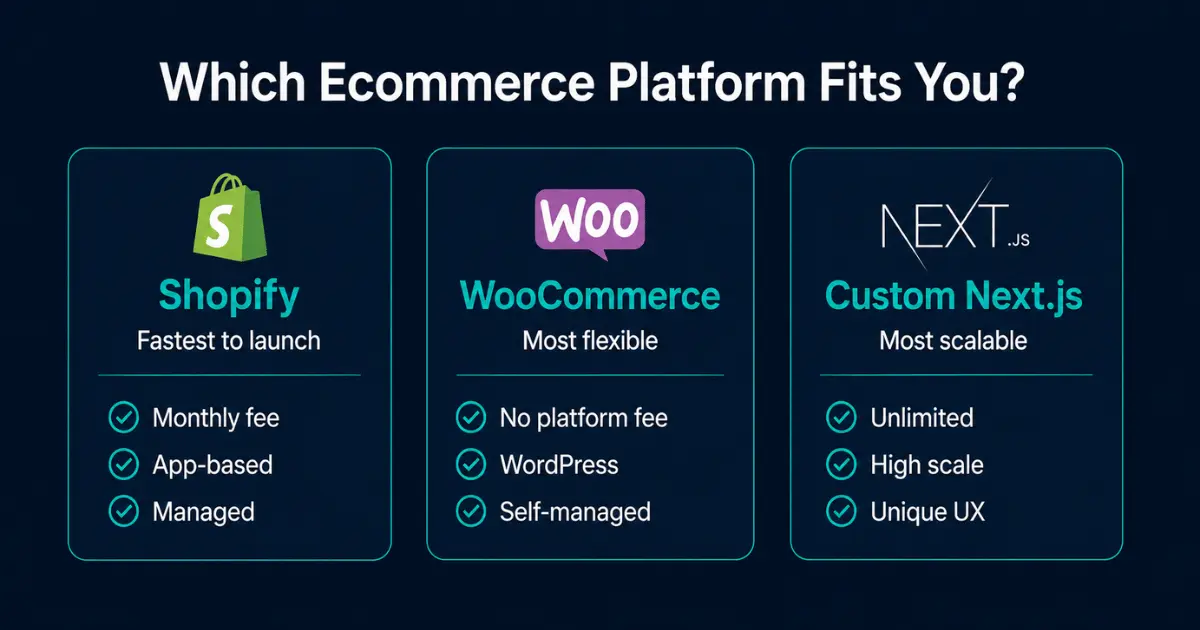
Quick recommendation:
- Just starting / want speed? → Shopify
- Want control + already on WordPress? → WooCommerce
- High traffic, custom experience, long-term scale? → Custom Next.js
There's no universally “best” platform — only the best fit for your catalogue size, budget, technical comfort and growth plans.
What Payment Gateways Work Best in India?
For Indian ecommerce, your payment gateway must support UPI, cards, net banking and wallets. The leading options in 2026:
- Razorpay — the most popular for Indian startups and SMEs. Easy integration, supports UPI/cards/EMI, strong dashboard.
- PayU — established, good for larger volumes, wide payment method support.
- Cashfree — competitive pricing, fast settlements, good for D2C.
- Stripe — best if you also sell internationally (now available in India).
Most gateways charge around 2% per transaction (lower for UPI). Always enable UPI — it accounts for over 80% of India's retail digital payment volume (Source: NPCI).
How Do You Handle Shipping and Delivery?
Shipping is where many first-time sellers stumble. You don't need contracts with individual couriers — use an aggregator:
- Shiprocket — India's most popular shipping aggregator. Connects Delhivery, Blue Dart, DTDC, Ecom Express etc. in one dashboard, with COD support.
- Delhivery — direct courier + fulfilment, strong pan-India reach.
- iThink Logistics / Nimbuspost — competitive alternatives with rate comparison.
Integrate the aggregator with your store so orders flow automatically to shipping labels and tracking. Offer COD — it still drives a large share of Indian ecommerce orders, especially in tier-2/3 cities.
What Features Does Every Indian Online Store Need?
Beyond the cart and checkout, a store that actually converts needs:
- Mobile-first design — 75%+ of Indian ecommerce traffic is mobile (Source: IBEF)
- UPI + COD — the two payment methods Indian shoppers expect
- Fast product search + filters — by price, category, size, brand
- Trust signals — reviews, ratings, return policy, secure-checkout badges
- WhatsApp support / order updates — India's preferred channel
- Abandoned-cart recovery — email/WhatsApp nudges to recover lost sales
- GST-compliant invoicing — automated tax invoices
- Fast loading (PageSpeed 90+) — every second of delay drops conversions
- SEO + schema markup — Product schema for rich results in Google
How Long Does It Take to Build an Online Store?
Realistic 2026 timelines from kickoff to launch:
- Shopify (basic): 2–4 weeks
- WooCommerce: 3–5 weeks
- Custom Next.js store: 6–12 weeks
- Multi-vendor marketplace: 12+ weeks
The biggest timeline variable isn't code — it's content readiness. Product photos, descriptions, pricing, categories and policy pages. Stores where the owner has content ready launch weeks faster. Start gathering high-quality product images and descriptions before development begins.
What Are the Ongoing Costs of Running an Online Store?
The launch price is one-time; running the store is ongoing. Budget for:
- Hosting: ₹500–₹5,000/month (WooCommerce/custom) or included (Shopify)
- Platform fees: Shopify ₹2,000–₹7,000+/month; WooCommerce/custom = ₹0 platform fee
- Payment gateway: ~2% per transaction
- Domain + SSL: ₹1,000–₹2,000/year
- Maintenance & updates: ₹3,000–₹15,000/month depending on scale
- Marketing: SEO, ads, social — the real growth lever
A realistic small-store running cost is ₹5,000–₹20,000/month all-in, before marketing. Plan for it so your margins survive.
Why Choose Freelancer Abhi to Build Your Online Store
Freelancer Abhi (ABHI & CO., UDYAM-HR-03-0143972) builds ecommerce stores for D2C brands, retailers and product businesses across Delhi NCR and India. Led by Abhishek Sharma — 7+ years experience, 50+ projects, 4.9/5 rating across 62+ reviews — we build on the platform that fits your business, not the one that pays the biggest commission.
Every store we build includes: mobile-first design, Razorpay + UPI + COD, Shiprocket integration, GST invoicing, Product schema for SEO, and PageSpeed 90+ performance. You work directly with the developer — no agency layers. Ecommerce stores start from ₹95,000.
Frequently Asked Questions
How much does it cost to build an ecommerce website in India?
A basic Shopify or WooCommerce store costs ₹40,000–₹1,20,000, while custom-built stores (Next.js/React) range from ₹1,50,000 to ₹5,00,000+ depending on features and scale. Remember ongoing costs too: hosting, ~2% payment gateway fees, and maintenance. At Freelancer Abhi, ecommerce stores start from ₹95,000 with fixed, transparent pricing.
Which is better for India — Shopify or WooCommerce?
Shopify is best if you want the fastest launch and don't mind monthly fees (₹2,000–₹7,000+). WooCommerce is better if you want full control, already use WordPress, and prefer no platform fees. For high-traffic brands needing a unique experience and maximum scalability, a custom Next.js store is the strongest long-term choice.
How long does it take to build an online store?
A basic Shopify store takes 2–4 weeks, WooCommerce 3–5 weeks, and a custom Next.js store 6–12 weeks. The biggest factor is content readiness — product photos, descriptions and pricing. Stores with content prepared in advance launch significantly faster.
What payment gateway is best for an Indian online store?
Razorpay is the most popular for Indian SMEs and startups — easy integration with UPI, cards, net banking and EMI. PayU and Cashfree are strong alternatives, and Stripe is ideal if you also sell internationally. Always enable UPI, as it drives the majority of Indian online payments.
Do I need to offer Cash on Delivery (COD)?
Yes, in most cases. COD still accounts for a large share of Indian ecommerce orders, especially in tier-2 and tier-3 cities where customers may hesitate to prepay. Shipping aggregators like Shiprocket support COD, and offering it typically increases conversions and order volume.
Conclusion
Building an online store in India in 2026 is more accessible than ever — but the right platform, payment setup and features make the difference between a store that sits idle and one that sells daily. Start with your catalogue size and budget, pick the platform that fits (not the trendiest one), and build mobile-first with UPI, COD and fast performance from day one.
Ready to sell online?
Book a free consultation and get a straight quote for your store — no jargon, no inflated pricing.
Related Articles You May Also Like
How Much Does a Website Cost in Delhi NCR in 2026?
Real 2026 price ranges, what drives the cost, and how to get genuine value.
Next.js vs WordPress in 2026: Which Platform Should You Choose?
A practical comparison to pick the right platform for your project.
Web Developer in Noida: Fast Websites for IT Companies & Startups (2026)
Custom Next.js websites for Noida IT companies and startups.
10 Signs Your Business Website Needs a Redesign in 2026
Warning signs your site is losing customers — and what a redesign costs.