10 Signs Your Business Website Needs a Redesign in 2026
A website redesign is the process of rebuilding a business website's structure, design, content and code to improve performance, user experience and search visibility — it goes beyond cosmetic changes to fix the technical and strategic issues that prevent a site from generating leads.
Your website is your most visible salesperson. It works 24/7, handles every first impression and shapes whether visitors become customers or bounce to a competitor. But websites age fast — what worked in 2022 or 2023 is already outdated by 2026 standards. Google's algorithms have changed, mobile usage has overtaken desktop in India, Core Web Vitals are now a confirmed ranking factor, and user expectations are higher than ever.
If you're noticing fewer enquiries, dropping rankings or an embarrassing PageSpeed score, your website is probably overdue for a redesign. Here are the 10 signs — and what to do about each one.
Not sure if your website needs a redesign?
Send your website URL and get an honest, no-pressure audit of what needs to change and what it'll cost.
At a Glance: 10 Signs Your Website Needs a Redesign
- PageSpeed score below 50 — slow sites lose 53% of mobile visitors (Source: Google)
- Not mobile-responsive — 73% of Indian internet users are mobile-only (Source: IAMAI)
- Bounce rate above 70% — visitors leave without engaging
- Design looks outdated — templates from 2018–2020 hurt credibility instantly
- No SSL certificate — Chrome marks HTTP sites as “Not Secure”
- Not ranking on Google — invisible to search = invisible to customers
- Low or zero lead generation — traffic but no enquiries
- Difficult to update content — if adding a blog post takes a developer, it's broken
- Competitors' websites look better — first impressions are relative
- Failing Core Web Vitals — Google's INP, LCP and CLS thresholds matter for rankings
How Do You Know Your Website Is Outdated?
Before diving into the 10 signs, here's a quick test: open your website on your phone, ask yourself three questions, and be honest.
- Does the page load in under 3 seconds?
- Can a first-time visitor understand what you do within 5 seconds?
- Is there a clear call-to-action (WhatsApp, call, form) visible without scrolling?
If the answer to any of these is “no,” keep reading.
Sign 1 — Your PageSpeed Score Is Below 50
| Metric | Outdated Website | Modern Redesigned Website |
|---|---|---|
| PageSpeed (mobile) | 20–45 | 90–100 |
| First Contentful Paint | 4–8 seconds | Under 1.5 seconds |
| Largest Contentful Paint | 6–12 seconds | Under 2.5 seconds |
| Time to Interactive | 8–15 seconds | Under 3 seconds |
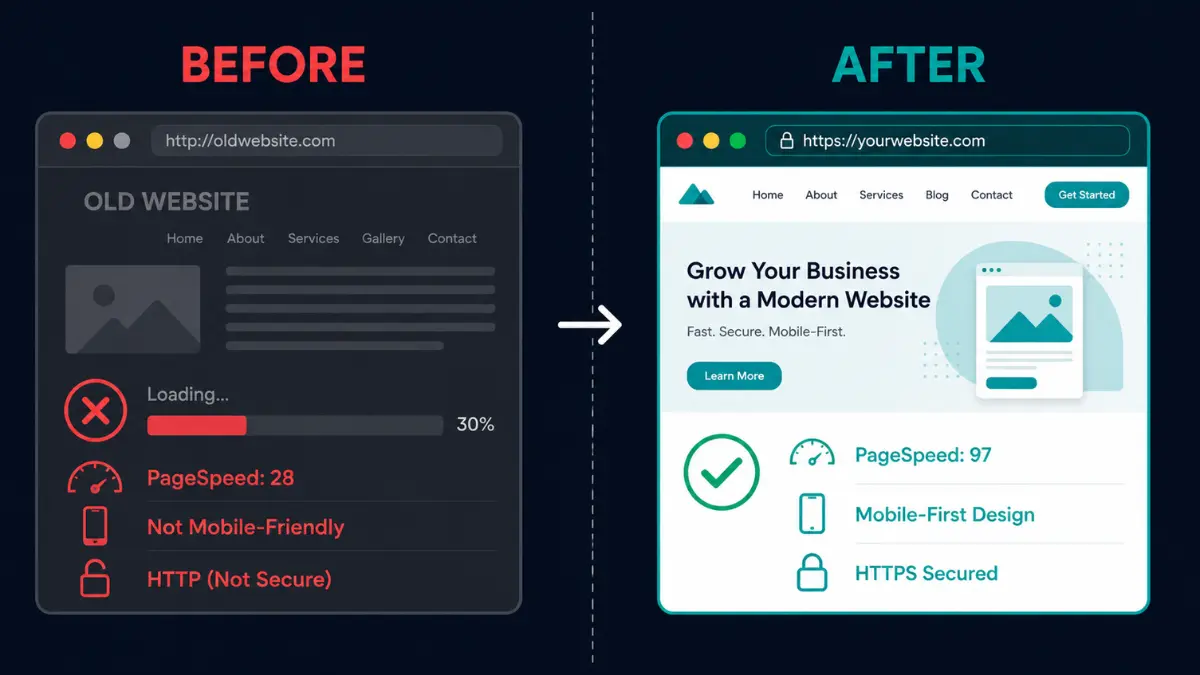
Google's own data shows that 53% of mobile users abandon sites that take over 3 seconds to load (Source: Google/SOASTA research). If your PageSpeed Insights score is below 50, you're losing more than half your mobile traffic before they even see your content.
Common causes: unoptimised images (JPEG instead of WebP), no code splitting, render-blocking CSS/JS, cheap shared hosting, and bloated WordPress themes with 30+ plugins.
Fix: A modern Next.js or clean WordPress rebuild with image optimisation, lazy loading and proper caching typically pushes the score to 90+ within 2–4 weeks.
Sign 2 — Your Website Isn't Mobile-Responsive
In 2026, 73% of Indian internet users access the web exclusively on mobile devices (Source: IAMAI Digital India Report 2025). If your website isn't fully responsive — meaning it adapts perfectly to every screen size — you're invisible to the majority of your potential customers.
Signs of poor mobile experience: text too small to read, buttons too close together, horizontal scrolling required, images cropped badly, pop-ups covering the screen.
Google uses mobile-first indexing, meaning it ranks your site based on the mobile version, not desktop. A desktop-only site will drop in rankings regardless of how good it looks on a laptop.
Sign 3 — Your Bounce Rate Is Above 70%
A bounce rate over 70% means most visitors leave your site after viewing just one page — they didn't click anything, didn't fill a form, didn't call you. For a business website, a healthy bounce rate is 40–60% (Source: Contentsquare Digital Experience Benchmark).
High bounce rates usually point to: slow loading (Sign 1), poor mobile experience (Sign 2), confusing navigation, weak above-the-fold content, or a design that looks untrustworthy.
Check it: Open Google Analytics → Engagement → Pages and screens. If your homepage bounce rate is above 70%, the redesign conversation needs to happen now.
Sign 4 — Your Design Looks Like It Was Built 5 Years Ago
Web design trends move fast. A site built in 2020 or earlier typically has: stock photography everywhere, generic slider banners, small text, flat colours with no depth, no micro-animations, and a layout that screams “WordPress template.”
Stanford's Web Credibility Research found that 75% of users judge a company's credibility based on website design (Source: Stanford Web Credibility Project). If your competitors have modern, clean, fast websites and yours looks dated, you're losing trust before the conversation even starts.
Modern 2026 standards: clean typography, generous whitespace, subtle animations, dark/light mode support, mobile-first layouts, and conversion-focused above-the-fold design.
Sign 5 — You Don't Have an SSL Certificate
If your website URL starts with http:// instead of https://, Chrome and Edge display a “Not Secure” warning in the address bar. This immediately kills trust — would you enter your phone number on a site marked “Not Secure”?
Beyond trust, Google has confirmed that HTTPS is a ranking signal (Source: Google Search Central). An HTTP site won't rank as well as an identical HTTPS site.
Fix: Free SSL via Let's Encrypt takes 10 minutes. But if your site is old enough to still be on HTTP, the SSL issue is just one symptom — the underlying platform and code likely need a full rebuild.
Sign 6 — Your Website Doesn't Rank on Google
You have a website, but when you search for your services in your city (e.g., “web developer in Faridabad” or “plumber near me”), you're nowhere in the results. This means your site has fundamental SEO problems: no keyword targeting, no meta tags, no structured data, thin content, poor internal linking, or technical crawl issues.
A redesign with proper SEO built in from the start — keyword research, on-page optimisation, schema markup, sitemap, and Core Web Vitals compliance — changes the trajectory completely. Most businesses see measurable ranking improvements within 60–90 days after a properly optimised redesign.
Sign 7 — You're Getting Traffic but Zero Leads
This is one of the most frustrating signs. You can see in Google Analytics that people visit your site — but nobody calls, nobody fills out the form, nobody sends a WhatsApp message.
Common conversion killers:
- No clear CTA above the fold — visitors don't know what to do next
- Contact form buried at the bottom — 80% of visitors never scroll that far
- No WhatsApp button — in India, WhatsApp is the preferred business communication channel
- No trust signals — no reviews, no certifications, no client logos
- Generic copy — “We provide quality services” says nothing specific
A conversion-focused redesign adds sticky CTAs, WhatsApp integration, prominent reviews, specific service pages and clear pricing — turning the same traffic into actual enquiries.
Sign 8 — Updating Content Requires a Developer
If adding a blog post, updating a phone number, changing a price or uploading an image requires you to call a developer and wait 2–3 days, your website's content management is broken.
Modern websites should give you a way to manage basic content without touching code. Whether it's WordPress's built-in editor or a headless CMS connected to a custom-coded site, you should be able to make routine updates yourself.
Red flag: If your developer built the entire site in raw HTML files with no CMS at all, every tiny change requires them. That's a dependency you can't scale with.
Sign 9 — Your Competitors' Websites Look Better
Open your top 3 competitors' websites side by side with yours. If theirs look cleaner, load faster, have better content, display Google reviews and rank above you — your website is actively losing you business.
This isn't about vanity. When a potential customer shortlists 3–4 options and visits each website, the one that looks most professional, loads fastest and makes it easiest to take action wins the enquiry. Web design is a competitive signal — and your competitors know this.
Sign 10 — You're Failing Core Web Vitals
Google's Core Web Vitals — LCP (Largest Contentful Paint), INP (Interaction to Next Paint) and CLS (Cumulative Layout Shift) — are confirmed ranking factors. If your site fails these metrics, Google deprioritises it in search results (Source: Google Search Central — Page Experience).
2026 thresholds:
| Metric | Good | Needs Improvement | Poor |
|---|---|---|---|
| LCP | ≤ 2.5s | 2.5–4.0s | > 4.0s |
| INP | ≤ 200ms | 200–500ms | > 500ms |
| CLS | ≤ 0.1 | 0.1–0.25 | > 0.25 |
Check yours at PageSpeed Insights. If any metric is in the red, a performance-focused rebuild is the fastest path to compliance.
How Much Does a Website Redesign Cost in India?
| Website Type | Redesign Cost (India 2026) | Timeline |
|---|---|---|
| Basic business website (5–8 pages) | ₹25,000 – ₹50,000 | 2–3 weeks |
| Custom Next.js website (8–15 pages) | ₹45,000 – ₹95,000 | 3–4 weeks |
| E-commerce store (50+ products) | ₹95,000 – ₹1,50,000+ | 4–6 weeks |
| WordPress redesign (theme + SEO) | ₹25,000 – ₹60,000 | 2–3 weeks |
Costs depend on page count, design complexity, features (e-commerce, booking, CRM integration) and whether you're rebuilding from scratch or migrating existing content. Always get a fixed written quote with clear scope before committing.
For detailed pricing: Website Development Cost in Delhi NCR 2026.
What Should a Modern 2026 Website Include?
Every modern business website should have:
- Mobile-first responsive design — perfect on every screen size
- PageSpeed 90+ — fast loading on Indian 4G networks
- SSL certificate — HTTPS, no exceptions
- Proper SEO — meta tags, schema markup, sitemap, keyword targeting
- Core Web Vitals compliance — LCP, INP, CLS all in green
- Clear CTAs — WhatsApp button, contact form, phone number above the fold
- Google reviews integration — social proof visible on the homepage
- Blog section — for SEO content and demonstrating expertise
- Structured data — LocalBusiness, Service, FAQ schemas for rich search results
- Analytics setup — Google Analytics 4 + Search Console from day one
Why Choose Freelancer Abhi for Your Website Redesign
Freelancer Abhi (ABHI & CO., UDYAM-HR-03-0143972) has redesigned 50+ websites for businesses across Delhi NCR and 10+ countries. Every redesign follows a proven process: audit the existing site, identify what's broken, plan the new structure, build with SEO baked in, and launch with Core Web Vitals compliance. You work directly with Abhishek Sharma — no middlemen, no junior handoffs.
Before/after results: clients typically see PageSpeed improvements from 30–40 → 95+, first-page Google rankings within 90 days, and 2–3× more enquiries within 3 months of the redesign.
View redesign portfolio | Read client reviews | Book a free website audit
Ready to fix what's broken? Send your website URL and get an honest audit — direct with the developer.
Frequently Asked Questions
How do I know if my website needs a redesign or just minor fixes?
If your PageSpeed score is below 50, your site isn't mobile-responsive, or you're failing Core Web Vitals, minor fixes won't solve it — you need a structural redesign. If the issues are limited to outdated images or copy, a content refresh may be enough. A free website audit identifies exactly which category your site falls into.
How long does a website redesign take in India?
A standard business website redesign (5–10 pages) takes 2–4 weeks. E-commerce or complex sites with migration take 4–6 weeks. Timeline depends on content readiness, number of pages, and custom features. At Freelancer Abhi, you get a fixed timeline in writing before any work begins.
Will I lose my Google rankings during a redesign?
Not if done properly. A professional redesign includes 301 redirects from old URLs to new ones, preserving all existing SEO equity. We also keep or improve your meta tags, schema markup and content. Most clients see rankings improve within 60–90 days after redesign, not drop.
Should I choose WordPress or custom-coded for my redesign?
WordPress is ideal if you need frequent content updates and want to manage things yourself. Custom-coded (Next.js/React) is better for speed, security and scalability — sites score 90–100 on PageSpeed vs 40–70 for typical WordPress. For a detailed comparison: Next.js vs WordPress 2026.
How much does a website redesign cost for a small business in India?
A basic business website redesign costs ₹25,000–₹50,000. Custom Next.js websites range from ₹45,000–₹95,000. E-commerce redesigns start at ₹95,000. All prices at Freelancer Abhi are fixed and transparent — no hidden charges. See the full breakdown: Website Development Cost Delhi NCR 2026.
Conclusion
If your website shows even 3–4 of these 10 signs, it's actively costing you customers. The longer you wait, the more leads go to competitors with faster, better-looking, properly optimised sites. A professional redesign in 2026 isn't a luxury — it's a business necessity.
Start with a free audit
Send your website URL and get an honest assessment of what needs to change and what it'll cost. No pressure, no obligations.
Related Articles You May Also Like
How Much Does a Website Cost in Delhi NCR in 2026?
Real 2026 price ranges, what drives the cost, and how to get genuine value.
Next.js vs WordPress in 2026: Which Platform Should You Choose?
A practical platform comparison for Indian business websites.
Why Next.js Is the Best Choice for Indian Business Websites in 2026
Faster loads, higher PageSpeed scores, stronger SEO and better security.
Freelance Web Developer vs Agency in India: Pros, Cons & Real Costs
Real 2026 cost data and a 7-point checklist before you commit.